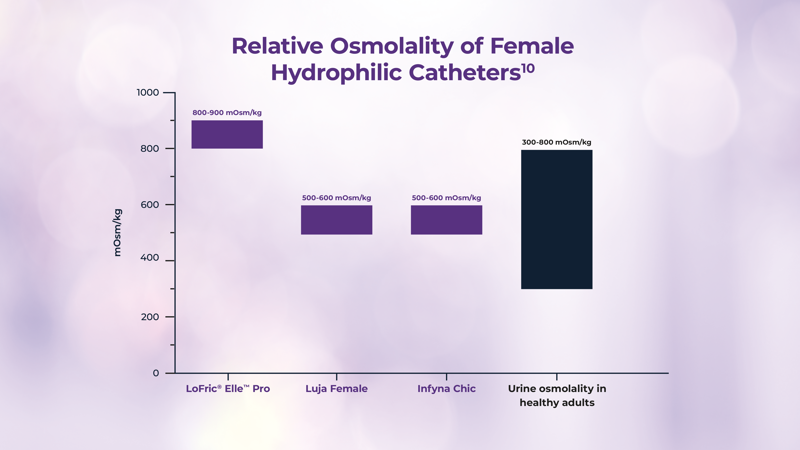
LoFric Elle Pro Make it work from day one

Discover how LoFric® Elle™ Pro can make ISC work for you

How LoFric Elle Pro works for complete bladder emptying

LoFric Elle Pro builds on the proven design of LoFric Elle, introducing twelve smooth Pro eyelets developed to further simplify catheterisation, support complete bladder emptying, and provide greater reassurance during use. 

In a user survey (n=196), participants reported that LoFric Elle supported learning and performing intermittent catheterisation from the start and helped build confidence during use (1).

Get a free sample

The teaching and learning experience

In a user survey (n=175), 52% of women report difficulties locating the urethra, and find it hard to position themselves correctly (4).

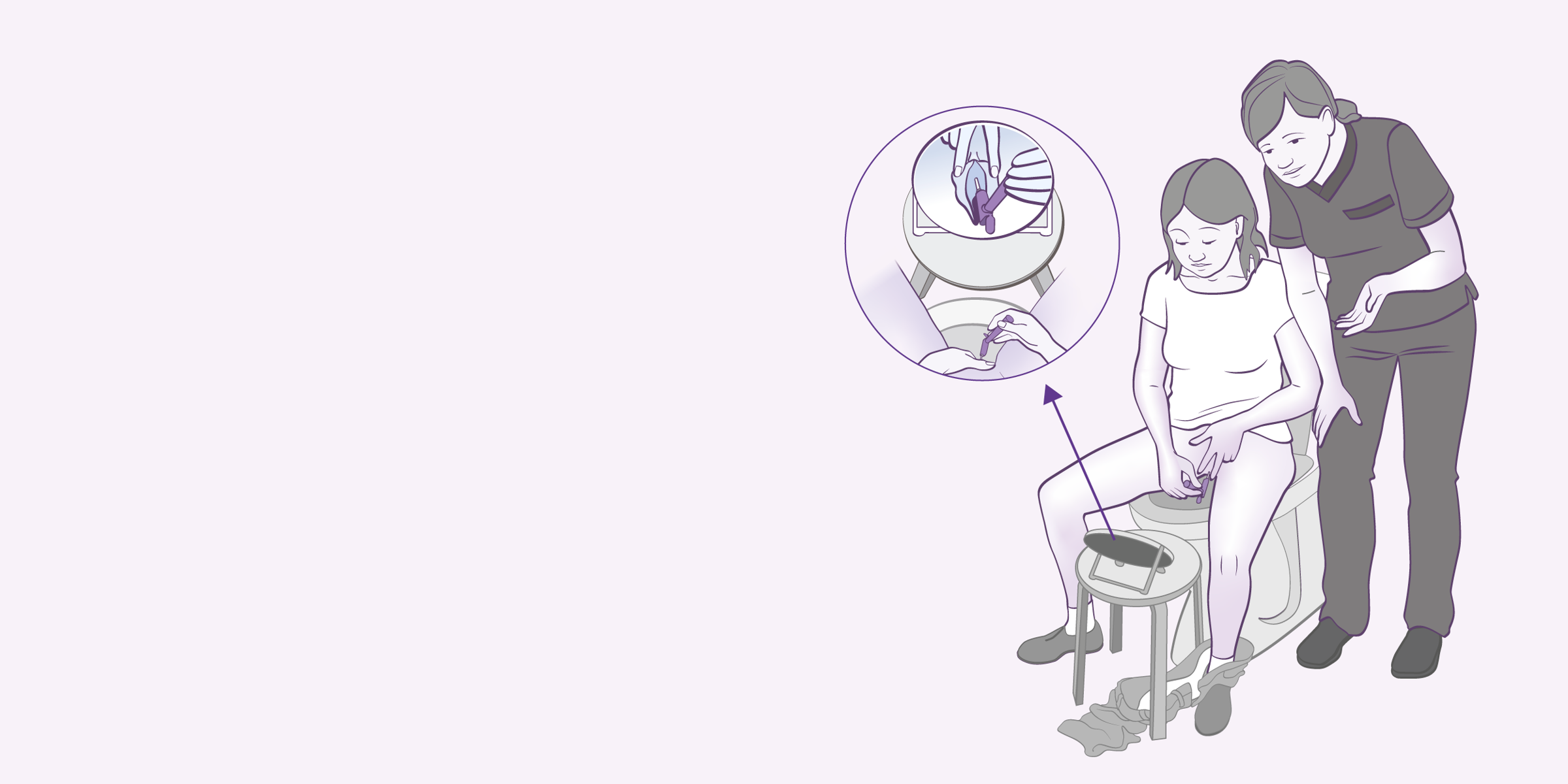
LoFric Elle Pro was designed to support learning and performing intermittent catheterisation. In user feedback, participants reported that the L-shaped handle supported visibility when using a mirror and made it easier for them to reach and identify the urethra in a natural sitting position (1, 5). 
The choice you can always trust

LoFric Elle Pro features the same Urotonic™ Surface Technology found across all LoFric products. Its smooth, lubricated surface helps ensure safe and gentle insertion and withdrawal, making it suitable for long-term use (6, 7, 8, 9).

The catheter’s tube is designed with an appropriate length to support complete bladder emptying.

Even when developing innovative functional designs, we never compromise on what matters most: the health and well-being of our users.

Why LoFric Elle is a sustainable choice

As the world’s first eco-labelled catheter for women, it proudly carries the Nordic Swan Ecolabel, confirming that it meets strict environmental criteria. 

  • Produced with 100% bio-based solvent.
  • Produced using 100% renewable energy.
  • The handle is 100% recyclable.
  • Manufactured with 0% PVC for a smaller carbon footprint.
    A switch from a PVC or Polyurethane catheter to a LoFric POBE based catheter, like LoFric Elle, could decrease the carbon footprint by as much as 20 kg CO2 every year (21).

References: 21 in total

  1. LoFric Elle user survey study, 2026, n=196 IC users introduced to LoFric Elle across 14 countries. Note: As LoFric Elle and LoFric Elle Pro share the same handle, results reflect user experience of the handle applicable to both products. Data on file at info@wellspect.com.
  2. Möhr S, Fassbind S, Gahl B, Seifert HH, Bausch K. Risk factors of bladder stones in neurogenic lower urinary tract dysfunction: A real-world study. BJUI Compass. 2024 Feb 1;5(3):359-365. doi: 10.1002/bco2.330. PMID: 38481672; PMCID: PMC10927923.
  3. Storme O, Tirán Saucedo J, Garcia-Mora A, Dehesa-Dávila M, Naber KG. Risk factors and predisposing conditions for urinary tract infection. Ther Adv Urol. 2019 May 2;11:1756287218814382. doi: 10.1177/1756287218814382. PMID: 31105772; PMCID: PMC6502981.
  4. LoFric Elle user survey study from 2024, n=175 female IC users in UK, evaluating real-life experience when introduced to IC therapy, focusing on IC barriers. Data on file at info@wellspect.com.
  5. LoFric Elle user and healthcare professional survey study, 2023, n=460 HCP and end users (HCP=224 and Users= 236), across 9 countries. Note: As LoFric Elle and LoFric Elle Pro share the same handle, results reflect user experience of the handle applicable to both products. Data on file at info@wellspect.com.
  6. Håkansson MA, Neovius K, Norrbäck M, Svensson J, Lundqvist T. Health Care Utilization and Complications Rates among Users Of Hydrophilic-Coated Catheters. Urol Nurs. 2015 Sep-Oct;35(5):239-47. PMID: 26630780.
  7. Bakke A, Digranes A, Høisaeter PA. Physical predictors of infection in patients treated with clean intermittent catheterization: a prospective 7-year study. Br J Urol. 1997 Jan;79(1):85-90. doi: 10.1046/j.1464-410x.1997.30018.x. PMID: 9043503.
  8. Waller L, Jonsson O, Norlén L, Sullivan L. Clean intermittent catheterization in spinal cord injury patients: long-term followup of a hydrophilic low friction technique. J Urol. 1995 Feb;153(2):345-8. doi: 10.1097/00005392-199502000-00014. PMID: 7815579.
  9. Taffo P, Amarenco G, Andersson C, Morris N, Hörling J. Long-term intermittent catheterization: Safety and outcomes from a prospective observational study. BJUI Compass. 2026 Apr 16;7(4):e70200. doi: 10.1002/bco2.70200. PMID: 42004048; PMCID: PMC13084324
  10. Wellspect test protocol, 2025, 2026.
  11. Jafari NV, Rohn JL. The urothelium: a multi-faceted barrier against a harsh environment. Mucosal Immunology. 2022 Jun;15(6):1127-1142. DOI: 10.1038/s41385-022-00565-0.
  12. Youhanna S, Bankir L, Jungers P, Porteous D, Polasek O, Bochud M, Hayward C, Devuyst O. Validation of Surrogates of Urine Osmolality in Population Studies. Am J Nephrol. 2017;46(1):26-36. doi: 10.1159/000475769. Epub 2017 Jun 7. PMID: 28586769; PMCID: PMC6080694.
  13. Perrier E, Vergne S, Klein A, Poupin M, Rondeau P, Le Bellego L, Armstrong LE, Lang F, Stookey J, Tack I. Hydration biomarkers in free-living adults with different levels of habitual fluid consumption. Br J Nutr. 2013 May;109(9):1678-87. doi: 10.1017/S0007114512003601. Epub 2012 Aug 31. PMID: 22935250; PMCID: PMC3638312.
  14. Armstrong LE, Johnson EC, McKenzie AL, Muñoz CX. Interpreting common hydration biomarkers on the basis of solute and water excretion. Eur J Clin Nutr. 2013 Mar;67(3):249-53. doi: 10.1038/ejcn.2012.214. Epub 2013 Feb 6. PMID: 23388665.
  15. Liao X, Liu Y, Liang S, Li K. Effects of hydrophilic coated catheters on urethral trauma, microtrauma and adverse events with intermittent catheterization in patients with bladder dysfunction: a systematic review and meta-analysis. Int Urol Nephrol. 2022;54:1461–1470.
  16. Lundgren, J., Bengtsson, O., Israelsson, A., Jönsson, A. C., Lindh, A. S., & Utas, J. (2000). The importance of osmolality for intermittent catheterization of the urethra. Spinal cord, 38(1), 45–50. https://doi.org/10.1038/sj.sc.3100935.
  17. Li YP, Liu W, Liu YH, Ren Y, Wang ZG, Zhao B, Huang S, Xu JZ, Li ZM. Highly improved aqueous lubrication of polymer surface by noncovalently bonding hyaluronic acid-based hydration layer for endotracheal intubation. Biomaterials. 2020 Dec;262:120336. doi: 10.1016/j.biomaterials.2020.120336.
  18. Johansson K, Greis G, Johansson B, Grundtmann A, Pahlby Y, Törn S, Axelberg H, Carlsson P. Evaluation of a new PVC-free catheter material for intermittent catheterization: a prospective, randomized, crossover study. Scand J Urol. 2013 Feb;47(1):33-7. doi: 10.3109/00365599.2012.696136. Epub 2012 Jul 5. PMID: 22762536; PMCID: PMC3549608.
  19. Waller, Telander and Sullivan. The importance of osmolality in hydrophilic urethral catheters: a crossover study. Spinal Cord, 1997, 35, 229-233.
  20. Witjes JA, Del Popolo G, Marberger M, Jonsson O, Kaps HP, Chapple CR. A multicenter, double-blind, randomized, parallel group study comparing polyvinyl chloride and polyvinyl chloride-free catheter materials. J Urol. 2009 Dec;182(6):2794-8. doi: 10.1016/j.juro.2009.08.047. 
  21. IVL Swedish Environmental Research Institute Report 2021. “Climate change impact comparison of catheter materials”.